 Skip to content

Speaking Spanish in a professional setting isn’t just about grammar By Núria Santiago, Spanish language coach
If you understand Spanish but freeze when you have to speak it in a meeting, a presentation or a negotiation, the problem isn’t your grammar or your vocabulary. Under pressure, your brain reads speaking a second language as a threat to your status, triggers a stress response and makes words harder to find. The good news: with conscious breathing, a shift of focus and regular practice in a safe context, you can train your brain to stay calm and speak Spanish as yourself.
Speaking Spanish in a professional setting isn’t only about grammar or vocabulary. It’s also about how your brain handles pressure.
Many international professionals and leaders I work with tell me the same thing:
“In English, I’m myself: confident, fast, clear. But when I speak Spanish, something changes. I freeze.”
If that sounds familiar, it doesn’t mean you’re bad at languages. It means your brain is doing exactly what it’s designed to do: protect you.
Why do I freeze when I speak Spanish, even though I understand it?
This experience is so common that researchers have a name for it: foreign language anxiety. It was first described by Elaine Horwitz and her colleagues in 1986, and it explains why so many people at an upper-intermediate or advanced level (B2–C1) understand almost everything but block when it’s their turn to speak.
For professionals, the block is often stronger. In your first language, you have years of credibility, experience and your own way of expressing yourself. In Spanish, you suddenly feel you’ve lost your voice, and with it part of your professional identity. That feeling of “this isn’t really me” is exactly what your brain reacts to.
What happens in your brain when you speak a second language under pressure
When you speak a non-native language, especially in high-stakes moments like a negotiation, a presentation or a team meeting, your brain perceives a threat to your status and self-image.
In that moment:
- The amygdala activates and sends alert signals.
- The prefrontal cortex, which handles working memory, word retrieval and decision-making, works less efficiently under acute stress (as neuroscientist Amy Arnsten’s research has shown).
- Your body enters fight-or-flight mode: cold hands, a racing heart, a blank mind, stuck sentences.
The result isn’t a lack of knowledge. It’s emotional interference. Your brain stops prioritising communication and focuses on survival instead.
Your brain isn’t failing you. It’s protecting you, just at the wrong moment.
How to stop freezing when speaking Spanish: 4 techniques that work
The good news is that neuroplasticity works in your favour. You can retrain your brain to stop linking Spanish with danger and start linking it with calm, control and confidence.
1. Breathe before you speak
A short, conscious pause with a slow exhale tells your nervous system that you’re safe. Two or three seconds is enough to lower the stress response and give your mind space to find the words.
It isn’t slowness. It’s leadership.
2. Focus on the message, not on perfection
Shift your attention from how you say it to what you want to say. When you speak from a clear purpose, your mind finds its rhythm, and the words follow. Perfect grammar can come later. Clarity comes first.
3. Change the emotion you link to Spanish
Before a meeting or presentation, repeat a few confidence phrases out loud:
- “I’m prepared.”
- “I can communicate what matters.”
- “My value doesn’t depend on my accent.”
This small ritual teaches your nervous system to respond with calm instead of alarm.
4. Practise in a safe space before the real moment
Your brain learns through experience. Speaking regularly in a relaxed, supportive context, before the meeting that really counts, builds the feeling of safety you need when the pressure is on. This is where language coaching makes the difference: you don’t just practise Spanish, you practise being yourself in Spanish.
You don’t need more words. You need a calmer brain.
Real results: when the brain feels safe, your authority comes back
I’ve coached professionals from around the world, including doctors, lawyers, engineers, executives and investors, who went from feeling blocked to speaking fluently.
They didn’t change the language. They changed their relationship with it.
Within weeks, they noticed their Spanish flowing more naturally in meetings, felt at ease when speaking and reconnected with their authentic voice. The turning point was always the same: understanding how their brain reacts under pressure, and learning to lead it.
“When your mind feels safe, your words follow.”
Why more vocabulary won’t fix a speaking block
Language blocks don’t disappear with another vocabulary list or another grammar book. They fade with the right combination of mental and linguistic training: practising real conversations about your work and your world while you learn to regulate your stress response.
That’s the approach behind my coaching, which combines Spanish, sport science and mindfulness. And the sooner you start, the sooner you’ll speak from your authority again.
Your brain already knows how to lead. It just needs to do it in Spanish, too.
Frequently asked questions
Is it normal to understand Spanish but not be able to speak it? Yes, very normal. Understanding (a receptive skill) usually develops faster than speaking (a productive skill). Add pressure and the fear of making mistakes, and the gap feels even bigger. It’s a matter of practice and emotional safety, not ability.
How long does it take to overcome the fear of speaking Spanish? It depends on the person, but many professionals notice a real change within a few weeks of regular conversation practice combined with simple stress-management techniques.
What’s the difference between Spanish classes and Spanish coaching? Classes usually focus on grammar and vocabulary. Spanish coaching focuses on helping you use the Spanish you already have, with confidence, in the situations that matter to you: meetings, presentations, conversations about your company and your life.
How can I prepare for an important meeting in Spanish? Prepare your key messages rather than a full script, practise them out loud, use a slow breath before you start speaking and remind yourself that your goal is to communicate, not to be perfect.
Speaking calmly is also a form of leadership
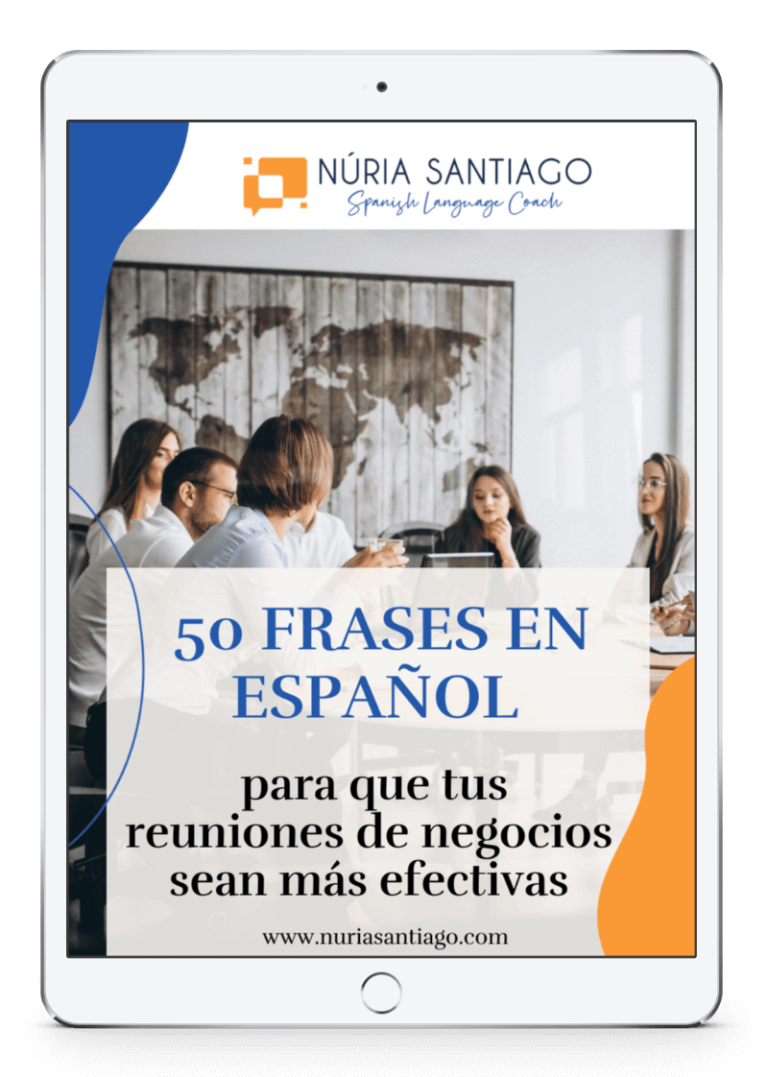
Take the next step: download your free guide and start speaking Spanish with more calm, clarity and confidence.
About the author Núria Santiago is a Spanish language coach based in Catalonia, Spain. With a background in Physical Activity and Sports Sciences and training in mindfulness, she helps international professionals speak Spanish naturally and confidently, as themselves. Speak Spanish. Grow inside and out.